The Principles Through a Leadership Lens
Whakamana: Empowerment Through a leadership lens, whakamana challenges us to move beyond compliance and focus on kaiako agency.
Rather than asking "How do I get my team to do what I want?", we might instead ask:
Empowering leaders recognise strengths, share decision-making, invite contribution and create opportunities for others to lead. Are your team waiting for your decisions, or are they developing the confidence to make their own?
Kotahitanga: Holistic Development
Kotahitanga reminds us that we do not just lead kaiako. We lead whole people. While most leadership frameworks focus just on performance, Te Whāriki reminds us that wellbeing, learning and performance are inseparable. Effective leaders consider kaiako wellbeing, workload, professional and cultural identity and their emotional resilience. When challenges arise, it is tempting to focus on the ‘symptoms’ rather than the underlying cause. Kotahitanga encourages us to look at the whole picture and understand the person behind.
Whānau Tangata: Family and Community
Leadership is fundamentally relational, not positional. People do not work in isolation, and centres do not operate in isolation. We are all influenced by our communities, experiences, whānau and relationships.
This principle invites leaders to:
When people feel known and understood, trust and commitment follow.
Ngā Hononga: Relationships
If there is one leadership principle that sits at the heart of Te Whāriki, it may well be ngā hononga. Simply put, trust is the curriculum of leadership. Before improvement comes relationship. Before accountability comes connection. Leaders who embrace ngā hononga focus on creating psychological safety through coaching conversations, respectful communication, honest feedback and genuine curiosity. Do your team experience your leadership as reciprocal or hierarchical? It is important as a leader to reflect on which principle is strongest in your practice and where you may need to focus more attention.
Rather than asking "How do I get my team to do what I want?", we might instead ask:
- How do I build decision-making capability?
- How do I strengthen the mana of others?
- How do I grow leadership throughout the team?
Empowering leaders recognise strengths, share decision-making, invite contribution and create opportunities for others to lead. Are your team waiting for your decisions, or are they developing the confidence to make their own?
Kotahitanga: Holistic Development
Kotahitanga reminds us that we do not just lead kaiako. We lead whole people. While most leadership frameworks focus just on performance, Te Whāriki reminds us that wellbeing, learning and performance are inseparable. Effective leaders consider kaiako wellbeing, workload, professional and cultural identity and their emotional resilience. When challenges arise, it is tempting to focus on the ‘symptoms’ rather than the underlying cause. Kotahitanga encourages us to look at the whole picture and understand the person behind.
Whānau Tangata: Family and Community
Leadership is fundamentally relational, not positional. People do not work in isolation, and centres do not operate in isolation. We are all influenced by our communities, experiences, whānau and relationships.
This principle invites leaders to:
- Listen before leading
- Consult authentically
- Build genuine partnerships with kaiako
- Understand the communities represented in their teams, where their kaiako come from and what they bring with them.
When people feel known and understood, trust and commitment follow.
Ngā Hononga: Relationships
If there is one leadership principle that sits at the heart of Te Whāriki, it may well be ngā hononga. Simply put, trust is the curriculum of leadership. Before improvement comes relationship. Before accountability comes connection. Leaders who embrace ngā hononga focus on creating psychological safety through coaching conversations, respectful communication, honest feedback and genuine curiosity. Do your team experience your leadership as reciprocal or hierarchical? It is important as a leader to reflect on which principle is strongest in your practice and where you may need to focus more attention.
The Strands: The Leadership Culture We Create
The Goals: Creating the Environment
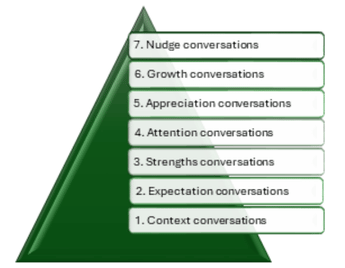
The Seven Conversations: Bringing the Goals to Life
Linda Hutchings' Seven Conversations model
provides a practical way of creating these conditions.
Context and expectation conversations help people understand where they fit and what success looks like. They support the goals of helping kaiako know they have a place and feel comfortable with the routines and customs of the organisation.
Strengths and attention conversations affirm people as individuals. They communicate that kaiako are seen, known and valued.
Appreciation conversations nurture emotional wellbeing. Small acts of recognition often have a significant impact on morale and engagement.
Growth conversations encourage kaiako to learn with and alongside others, while coaching and feedback create opportunities for creativity, reflection and professional growth.
Even nudge conversations, when handled respectfully, help people strengthen their thinking, reasoning and problem-solving capabilities.
These conversations create the conditions where kaiako know they have a place, feel valued, understand expectations, develop confidence and continue growing. Importantly, they remind us that leadership is not a single event. It is an ongoing series of interactions that affirm, challenge and support people over time.
The result is a leadership approach that intentionally supports the growth and development of every individual in the team.
The Learning Outcomes: A Powerful Reminder for Leaders
Weaving a Leadership Whāriki